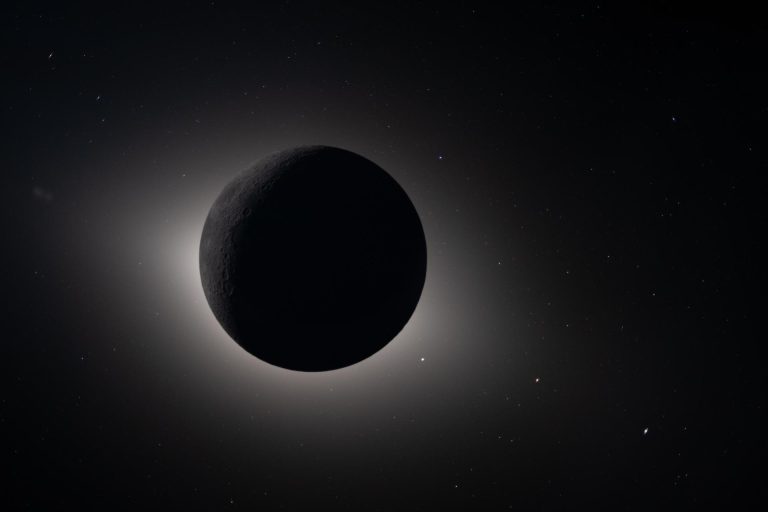

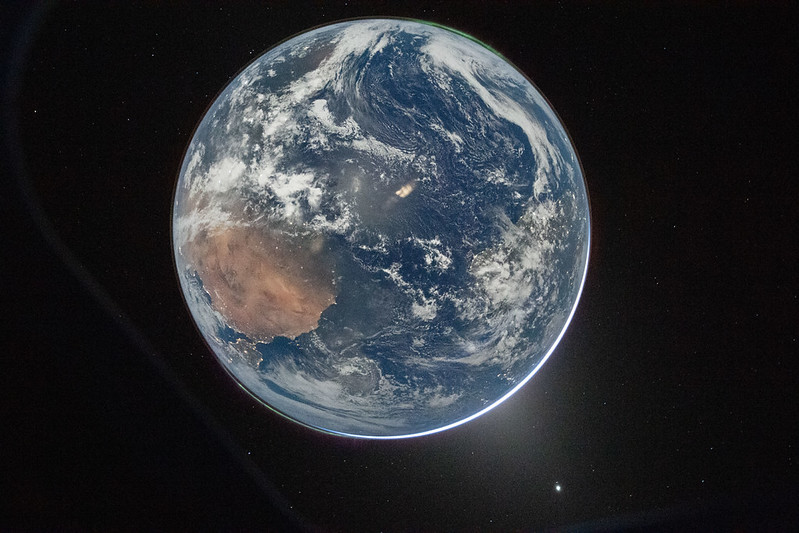

On April 1, 2026, humanity took its most significant leap toward the stars in over half a century. The launch of the Artemis II mission from Kennedy Space Center marked the first time since 1972 that a crewed spacecraft has ventured beyond low Earth orbit. While the mission is a triumph of engineering, validating the Space Launch System (SLS) and the Orion spacecraft Integrity, it has also gifted the world a new perspective of our home through the "Hello World" photograph.
The Shot Heard 'Round the World (and Beyond)
Captured on April 2, 2026, by mission commander Reid Wiseman, the "Hello World" image is the first in-person photograph of the entire Earth as a complete sphere since the famous "Blue Marble" of 1972. Taken from a distance of over 180,000 kilometers as the crew sped toward the Moon, the photo reveals a "mystical" view of our planet eclipsing the Sun.
The composition is breathtaking: the Atlantic Ocean and the Sahara Desert are centered, with shimmering green auroras dancing at both poles and the pin-point light of Venus glowing in the corner.
The Tech: Why DSLR Captured the Moment
There has been much debate among photography enthusiasts regarding the gear used for such a prestigious mission. While NASA has extensively tested the Nikon D5 for space use, certifying its ability to survive extreme thermal vacuums ranging from -30°C to +40°C and even added a flagship mirrorless Nikon Z9 to the manifest at the last minute, the "Hello World" shot was captured with a DSLR legend: the Nikon D5.
Why use a DSLR a 2026 Moon mission? The answer lies in two critical factors:
- Radiation Resistance: The Nikon D5 is a "known quantity." It has been proven it can withstand the constant bombardment of cosmic radiation without sensor degradation.
- Low-Light Mastery: Unlike the "Blue Marble," which was shot in direct sunlight, "Hello World" shows Earth’s nighttime side illuminated only by indirect moonlight. To capture this, Wiseman used extreme settings: ISO 51,200, a 1/4-second shutter speed, and a Nikkor 14-24mm f/2.8 lens opened to f/4. The D5’s specific sensor architecture remains one of the best high-ISO performers ever built, making it the superior tool for "conquering the dark".
A Record-Breaking Journey
As the crew of Reid Wiseman, Victor Glover, Christina Koch, and Jeremy Hansen continued their 10-day odyssey, they didn't just take photos; they made history. On April 6, 2026, Artemis II officially broke the record for the farthest distance humans have ever traveled from Earth, reaching a maximum distance of 252,760 miles surpassing the record set by the legendary Apollo 13 mission.
Credit: NASA